


 0 / 5
0 / 5 


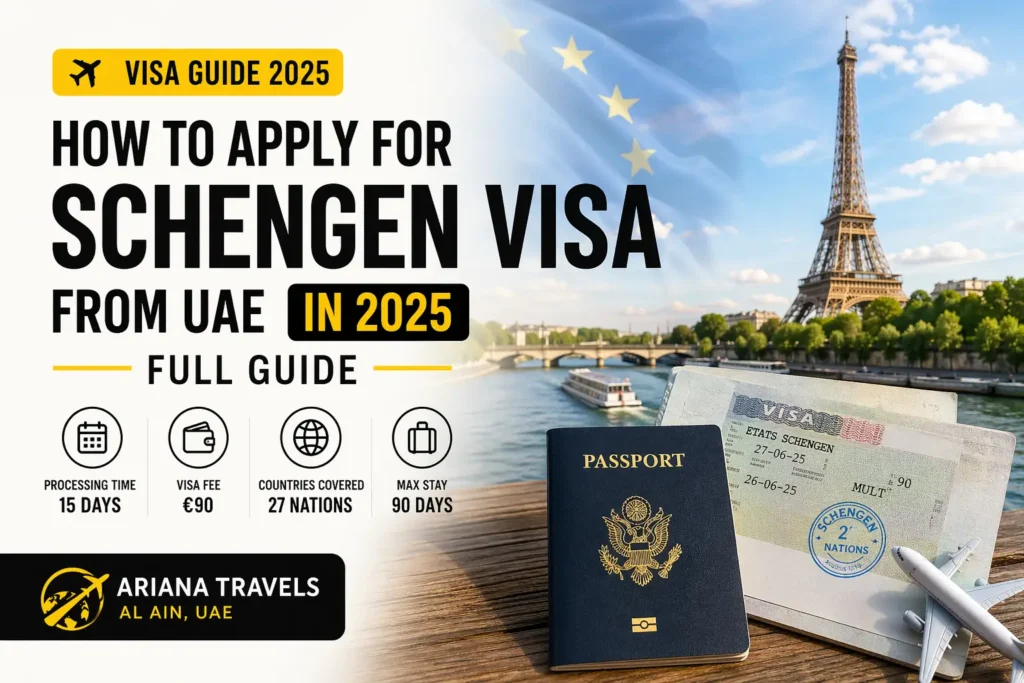
How to Apply for Schengen Visa from UAE in 2026: Full Guide
What Is a Schengen Visa?
A Schengen visa is a short-stay travel permit that allows you to visit up to 27 European countries with a single visa. For UAE residents — whether holding a UAE passport or a residency visa — the Schengen visa opens the door to exploring countries like France, Germany, Italy, Spain, the Netherlands, Austria, Belgium, and more without needing separate visas for each country. It is arguably the most powerful single visa a traveller can hold, unlocking an entire continent of culture, history, food, and architecture.
The Schengen Area was established under the Schengen Agreement, and it covers most of the European Union plus a few non-EU countries like Switzerland, Norway, Iceland, and Liechtenstein. Once issued, your Schengen visa lets you travel freely within the entire zone for up to 90 days within any 180-day period. This means you can fly into Paris, travel overland to Amsterdam and Berlin, then hop down to Rome — all on the same visa with no border checks between countries.
For Ariana Travels clients in Al Ain, the Schengen visa is one of the most requested services we handle year-round. Our team has helped thousands of UAE residents across all nationalities — Pakistani, Indian, Filipino, Egyptian, and many more — successfully obtain their Schengen visas and travel to Europe without stress or complications.
💡 Important for UAE Residents: Even if your home country has a visa-free arrangement with Schengen countries, your UAE residency does not automatically grant visa-free access. Always check requirements based on your passport nationality, not your residence. Our team at Ariana Travels visa services will confirm exactly what applies to your passport.
Understanding the Schengen Border-Free Zone
The Schengen Area represents one of the greatest achievements in modern travel — a region of 27 countries where internal border controls have been abolished entirely. When you hold a valid Schengen visa, you can cross between member states as freely as moving between emirates within the UAE. There are no passport checks, no immigration queues, and no additional visas required as you travel from one country to the next.
This makes the Schengen visa exceptionally versatile for holiday planning. A single two-week trip can realistically take you from the beaches of the French Riviera through the Alps of Switzerland into the romantic streets of Vienna and then down to the canals of Venice. The freedom to combine destinations within one trip is what makes Europe so attractive for UAE residents booking tour packages from Al Ain.
It is important to understand, however, that the Schengen Area is not the same as the European Union. Some EU countries such as Ireland and Cyprus are not in Schengen, while non-EU countries like Norway, Switzerland, and Iceland are. Always confirm whether your destination requires a separate visa or falls within Schengen before finalising your travel plans.
Types of Schengen Visas
Before applying, it is important to choose the correct visa type based on your travel purpose. Applying for the wrong category is one of the most common mistakes applicants make, and it can lead to delays or rejection:
| Visa Type | Purpose | Duration |
|---|---|---|
| Type C – Tourist | Leisure, sightseeing, holiday | Up to 90 days |
| Type C – Business | Meetings, conferences, trade fairs | Up to 90 days |
| Type C – Family Visit | Visiting relatives in Schengen Area | Up to 90 days |
| Type C – Medical | Medical treatment in Europe | Based on treatment |
| Type D – Long Stay | Work, study, long-term residency | More than 90 days |
Most UAE residents travelling for tourism or leisure apply for a Type C Tourist Schengen Visa, which is the most common and straightforward option. If you are travelling for business purposes — attending trade shows, client meetings, or corporate conferences — a Type C Business visa is required even if the trip duration is identical. The supporting documents will differ slightly for each category, and our visa services team in Al Ain will guide you on which type best fits your travel purpose.
Which Embassy Should You Apply To?
This is one of the most common questions UAE residents ask. The rule is simple: apply at the embassy of the country where you will spend the most days.
For example, if your itinerary covers 5 days in Paris, 3 days in Amsterdam, and 2 days in Brussels, you should apply at the French Embassy since France is your primary destination. If all countries have equal days, apply at the first country of entry.
All Schengen embassies in the UAE accept applications from residents, regardless of nationality. Dubai, Abu Dhabi, and major cities have visa application centres (VACs) for most countries, including VFS Global and TLS Contact centres. If you are unsure which embassy to apply to based on your planned itinerary, the team at Ariana Travels can review your travel plans and advise on the correct embassy before you begin the application process.
Applying to the wrong embassy is one of the most common reasons for application rejection or transfer, and it wastes valuable time especially during peak season when appointment slots are scarce. Getting this right from the start is critical.
Step-by-Step: How to Apply for Schengen Visa from UAE
-
Determine Your Destination & Embassy
Identify your main destination country and visit the official embassy website or their authorised visa centre (VFS Global or TLS) in UAE to confirm requirements and available appointment slots. If you are planning a multi-country trip, calculate which country will host you for the most nights. Contact Ariana Travels if you need guidance on which embassy best fits your itinerary.
-
Book Your Visa Appointment
Schedule an appointment online through the VFS or TLS portal. During peak season (summer, Christmas), appointments can fill up 3–5 weeks in advance. Book early — we strongly recommend securing your appointment slot at least 6 weeks before your intended travel date. Our team can also advise on appointment availability and the best times to apply for your chosen destination.
-
Gather All Required Documents
Compile your full document set including your passport, photos, bank statements, hotel bookings, travel insurance, cover letter, and more (see full checklist below). Incomplete documentation is the number one reason for rejection. Our visa specialists provide a personalised document checklist tailored to your specific embassy and travel circumstances.
-
Pay the Visa Fee
As of 2024, the standard Schengen visa fee is €90 (approx. AED 360) for adults and €45 for children aged 6–11. Children under 6 are exempt. Fees are non-refundable regardless of outcome. Some embassies charge an additional service fee through their authorised centres (VFS or TLS), which typically ranges from AED 120–160. These fees are separate from any service fee charged by Ariana Travels.
-
Submit Your Application
Attend your appointment in person, submit biometric data (fingerprints and photo), and hand over all documents. Some embassies accept applications through authorised travel agents. Dress professionally for your appointment — first impressions matter. Bring original documents as well as clear photocopies of everything. Ariana Travels prepares clients thoroughly so they walk into the visa centre confident and fully prepared.
-
Wait for Processing & Collect Visa
Standard processing time is 15 calendar days. In busy periods, it may take up to 30 days. You will be notified when your passport is ready for collection. Never book non-refundable flights until your visa has been approved. Our team tracks application statuses and keeps you informed throughout the waiting period so there are no surprises.
Required Documents Checklist
Below is the standard document checklist for a tourist Schengen visa from UAE. Some embassies may have additional requirements, and requirements can change. Always verify with the specific embassy or with our visa services team before submitting:
- Original passport valid for at least 3 months beyond your planned return date with at least 2 blank pages
- Completed and signed Schengen visa application form (specific to the embassy you are applying to)
- 2 recent passport-sized photos (35mm x 45mm, white background, taken within last 6 months)
- UAE residence visa copy and Emirates ID (both sides, clear and in colour)
- Confirmed return flight bookings (showing departure and return dates — refundable or flexible tickets recommended)
- Hotel reservations or accommodation proof for the entire trip duration (every night must be accounted for)
- Travel insurance with minimum coverage of €30,000 valid for entire Schengen stay — we arrange this as part of our service
- Bank statements for the last 3–6 months (showing sufficient funds and regular transaction history)
- Cover letter explaining the purpose, itinerary, and duration of your trip in clear and professional language
- Proof of employment (salary certificate, NOC from employer) or business ownership documents
- For self-employed: Trade license, bank statements, and company documents showing active business
- Previous Schengen visa copies if applicable — a strong travel history significantly improves your application
- Tenancy contract or proof of UAE residence (utility bill or ADDC/DEWA bill) to strengthen ties to UAE
💡 Pro Tip: How Much Bank Balance Is Enough?
Most embassies recommend a minimum of €50–100 per day of stay. For a 10-day trip, you should ideally show at least €500–1,000 in liquid funds. However, having a consistent transaction history matters more than a single large deposit before the application date. Embassies look for patterns — a steady salary, regular spending, and no sudden large cash injections. Our team at Ariana Travels advises every client individually on their financial documentation strategy.
Schengen Visa Fees in 2025
| Applicant Category | Standard Fee (EUR) | Approx. AED |
|---|---|---|
| Adults (18 and above) | €90 | ~360 AED |
| Children (6–11 years) | €45 | ~180 AED |
| Children under 6 | Free | Free |
| VFS / TLS Service Fee (varies) | ~€30–40 | ~120–160 AED |
Keep in mind that visa fees are paid directly to the embassy or authorised centre and are entirely non-refundable in the event of rejection. This is why it is so important to submit a strong, well-prepared application the first time. Ariana Travels' visa preparation service is specifically designed to maximise your approval chances and avoid costly reapplication fees.
Schengen Visa Processing Time from UAE
The standard processing period is 15 calendar days from the date of application. However, actual timelines vary depending on the embassy and the time of year. Understanding these timelines is critical for planning your trip correctly and avoiding last-minute panic.
Regular season (Oct–Apr): 7–15 working days. Peak season (Jun–Sep, Dec): 15–30 days. Always apply at least 4–6 weeks before your intended travel date to avoid delays, especially in summer. For Schengen visas from Al Ain, the application is submitted at the relevant embassy's authorised visa centre in Dubai or Abu Dhabi, both of which are easily accessible.
Some countries like France, Germany, and the Netherlands offer priority processing for an additional fee, which can reduce the wait to 3–5 days. This is ideal if you have an urgent trip or a last-minute travel requirement. Ask the visa centre about availability when booking your appointment — or let our team at Ariana Travels advise you on which embassies currently offer expedited processing.
It is worth noting that embassies can legally take up to 30 days in certain circumstances, and in exceptional cases up to 60 days. Never book non-refundable flight tickets before your visa has been stamped in your passport. Most good travel agents and airlines offer flexible booking options that protect you during the application period — this is something we always discuss with clients when planning their Europe tour packages from Al Ain.
Tips to Increase Your Schengen Visa Approval Chances
Getting your Schengen visa approved comes down to presenting a strong, consistent, and credible application. Embassies are looking for evidence that you are a genuine tourist who has the means to fund the trip and the intention to return to the UAE after it. Here are the most important tips from our experienced visa specialists in Al Ain:
1. Apply at the Right Embassy
Always apply at the embassy of the country you will spend the most time in. If days are equal, apply at your first point of entry. Applying at the wrong embassy is a common reason for rejection or costly transfer delays. Our team always verifies this before any application begins.
2. Book Refundable Flights and Hotels
You need confirmed bookings at the time of application. To avoid financial risk in case of rejection, use refundable options or booking platforms that allow free cancellation within 24–48 hours. Never book non-refundable tickets before your visa is confirmed. We guide clients on which booking platforms work best for visa applications.
3. Write a Clear and Detailed Cover Letter
Your cover letter should explain who you are, your travel purpose, your detailed day-by-day itinerary, why you plan to return to the UAE after the trip, and your financial means to support the journey. Keep it professional, factual, and consistent with all other supporting documents. A well-written cover letter can make a significant difference in borderline cases. Ariana Travels prepares cover letters as part of our comprehensive visa assistance service.
4. Maintain a Healthy and Consistent Bank Account
Avoid making large cash deposits right before applying. Embassies analyse your entire banking history, not just your current balance. They prefer to see a steady income flow, regular expenses, and a balance that has been maintained over months — not a sudden spike the week before application. If you have savings in multiple accounts, include statements from all of them to paint the clearest financial picture.
5. Have Strong Ties to the UAE
Employment, property ownership, family dependants, or a long-term residence in the UAE gives embassies confidence that you will return after your trip. Include supporting documents such as your employment contract, salary slips, tenancy agreement, and proof of family members residing in the UAE. The stronger your ties, the easier it is for the consular officer to approve your application.
6. Present a Realistic and Logical Itinerary
Your planned itinerary should be realistic — do not plan to visit 10 countries in 7 days. Embassy officers review itineraries carefully and are experienced at spotting applications that do not make practical sense. A clear, reasonable day-by-day plan that matches your hotel and flight bookings creates a compelling and credible application.
Countries You Can Visit on a Schengen Visa
With a single Schengen visa, you can visit all 27 member countries. The most popular among UAE residents for holiday packages from Al Ain include:
France (Paris, Nice, Lyon) · Germany (Berlin, Munich, Frankfurt) · Italy (Rome, Milan, Venice) · Spain (Barcelona, Madrid, Seville) · Netherlands (Amsterdam, Rotterdam) · Austria (Vienna, Salzburg, Innsbruck) · Belgium (Brussels, Bruges, Ghent) · Switzerland* (Zurich, Geneva, Bern) · Greece (Athens, Santorini, Mykonos) · Portugal (Lisbon, Porto, Algarve) · Poland (Krakow, Warsaw) · Czech Republic (Prague) · Hungary (Budapest) · Croatia (Dubrovnik, Split)
*Switzerland is not an EU member but is part of the Schengen Area.
Each of these destinations offers a distinct experience. Paris is the world's most visited city for a reason — its museums, cuisine, and boulevards are in a class of their own. Italy's diversity of art, architecture, and food makes it perfect for first-time European visitors. Greece offers the perfect combination of ancient history and stunning island scenery. If you are planning a budget-friendly Europe trip, Eastern European Schengen countries like Poland and the Czech Republic offer remarkable value compared to their Western counterparts.
What to Do After Your Schengen Visa is Approved
Once your Schengen visa is stamped in your passport, there are a few important things to do before you depart. First, carefully check all details on the visa sticker — your name spelling, passport number, valid dates, number of entries, and the country of issuance. Errors should be reported to the visa centre immediately.
Check the visa type — a single-entry visa means you can only enter the Schengen Area once, while a multiple-entry visa allows you to exit and re-enter during the validity period. If you plan to leave and re-enter (for example, visiting the UK as part of your trip and then returning to France), you will need a multiple-entry visa.
Make sure your travel insurance is active and accessible on your phone or as a printed document. Keep digital and physical copies of all your travel documents — hotel bookings, flight tickets, and the visa itself. If you require any additional bookings such as excursions or guided tour packages, confirm all details before departure. Our team at Ariana Travels remains available even after your visa is approved to assist with any last-minute travel arrangements.
Frequently Asked Questions
Ready to Travel to Europe?
Let Ariana Travels handle your Schengen visa application from Al Ain. Fast processing, expert guidance, and complete document support — all under one roof.
Get Your Schengen Visa Now →